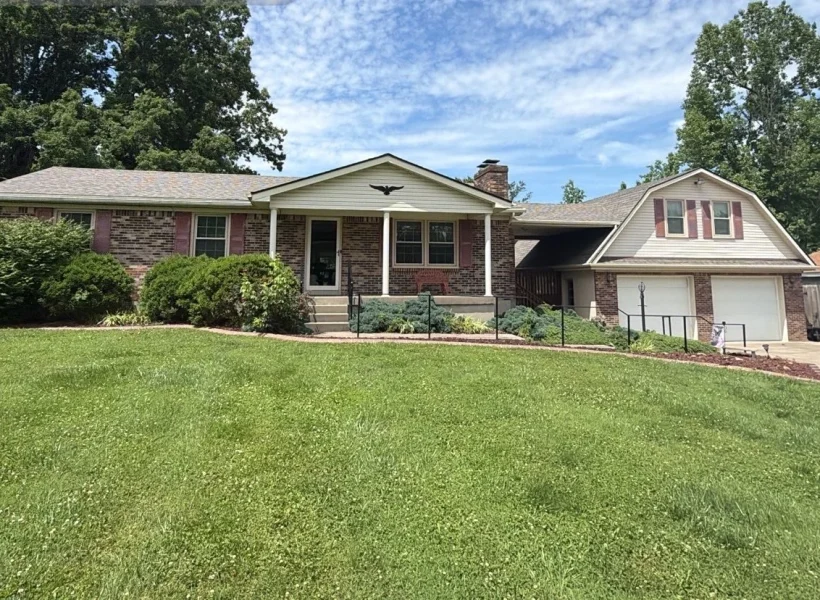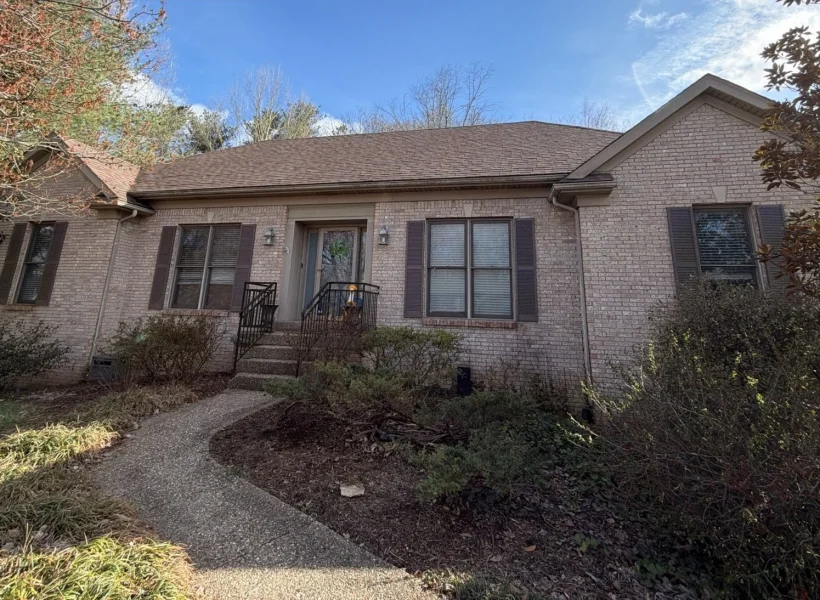


Hail damage documentation is a precise exercise — each chalk circle marking an individual impact site where granule displacement and fiberglass mat bruising confirm a qualifying storm event. This Douglass Hills brick ranch had those marks distributed across its roof surface in the unmistakable density pattern that adjusters recognize as legitimate storm damage rather than normal wear. Ragnar Roofing provided the free inspection, built the documentation, worked with the insurance company, and secured full replacement approval — getting the homeowner a brand new Tamko Titan XT roof paid for by their policy. The project also uncovered aged skip sheathing underneath that required deck board replacement before anything new went down, and the multiple skylights on this home received proper new flashing integration into the completed shingle system.
Skip Sheathing — The Detail Most Homeowners Never Know About
Older homes in Kentucky frequently have skip sheathing rather than plywood or OSB under their roofing — spaced boards laid across the rafters rather than a continuous solid deck. The tear-off revealed exactly that condition on this Douglass Hills ranch, with aged, weathered boards showing decades of service alongside gaps between them that modern roofing systems aren’t designed to bridge. Installing underlayment and shingles directly over deteriorated skip sheathing creates fastener pull-through risks, irregular surface conditions that affect shingle alignment, and performance gaps that show up in the next significant wind event.
New deck boards were installed to address the compromised sections before underlayment went down — turning what the tear-off revealed into a properly prepared substrate rather than a problem covered over and ignored.
What the Free Inspection Found
The chalk-marked impact documentation captured on this roof shows hail strike patterns distributed across the shingle field with the spacing and density that distinguishes a genuine storm event from isolated surface damage. Individual circles mark each confirmed impact site — points where the granule surface was displaced and the mat beneath compromised — spread across multiple sections of the roof in a way that mirrors the storm’s path across the property. Finding this distribution consistently across the surface rather than concentrated in one area is the evidence pattern that holds up when insurance carriers scrutinize the claim.
Ragnar Roofing’s free inspection covered every slope methodically, produced thorough photographic documentation of each impact zone, and compiled a file that the carrier couldn’t reasonably dispute.
H2: Getting the Claim Approved
Full replacement approval on a storm damage claim doesn’t happen by accident — it happens because the documentation submitted to the carrier is complete, credible, and specific enough that denial requires the company to argue against its own policy terms. The combination of impact density across multiple slopes, deck condition revealed at tear-off, and existing skylight flashing that had reached the end of its service life gave the claim a well-rounded scope that supported full replacement rather than selective repairs. Insurance approved the complete re-roof, and the homeowner paid their deductible while their policy covered everything else.
That outcome — a brand new roof on a home that the homeowner might have deferred replacing for another several years without a storm claim — reflects what genuine insurance advocacy produces when the contractor knows what to look for and how to present it.
Skylight Flashing Rebuilt Into the New System
This home carries multiple skylights on its main roof slope — both fixed-frame units and what appears to be an operable unit with a fresh aluminum frame visible in the completed rooftop detail. Skylights are the penetration type that generates the most roof-related interior water calls on older homes, because original skylight flashing ages and loses its seal integrity at the junction between the glass frame and the surrounding shingle field long before the shingles themselves show obvious failure. Rebuilding the flashing around each skylight — step flashing up the sides, head flashing at the upper frame edge, and properly integrated shingles at each course transition — was part of the scope completed during the Titan XT installation.
The fresh aluminum flashing visible around the new skylight frames in the completed rooftop detail confirms these penetrations were treated as full integrations into the new system rather than left with their original flashings beneath new shingles.
Tamko Titan XT on a Classic Brick Ranch
Deep charcoal Tamko Titan XT shingles now cover the full surface of this Douglass Hills brick ranch — a color that works naturally with the warm red brick exterior, dark shutters, and established mature landscaping visible from the street. The completed front elevation shows the finished roofline from the homeowner’s perspective: clean, consistent shingles running from ridge to eave with low-profile attic vents integrated flush into the field and the large brick chimney receiving new step flashing at its base. The Titan XT’s Class 3 impact rating brings meaningful performance improvement over whatever standard dimensional product the original installation used — a relevant upgrade for a home that just documented its vulnerability to hail events.
The Ragnar Roofing yard sign visible in the completed street view reflects a homeowner confident enough in the finished result to let it advertise the work to every neighbor who drives past.
Multiple Low-Profile Vents and Penetration Details
A series of low-profile attic vents runs along the roof field on this home — four units visible in the completed rooftop detail, each set flush into the shingle field with new boot-style flashing integrated into the surrounding shingle courses. Attic ventilation on a ranch home this size matters for both comfort and roof longevity — proper exhaust at the vent locations, drawing intake air from the soffit perimeter, keeps attic temperatures from building to the levels that accelerate shingle aging from below and create ice dam conditions at the eaves in winter. These vents received new flashings as part of the installation rather than being left with their original seals on a new shingle surface.
Every penetration on this roof — vents, skylights, pipe boots, and chimney — was treated as part of the complete system rather than an afterthought addressed only if the homeowner specifically noticed a problem.
Storm Damage Roofing by Ragnar Roofing
Douglass Hills homeowners with storm-damaged roofs have a direct path to a fully funded replacement when they work with a contractor who inspects thoroughly, documents precisely, and advocates persistently through the claims process. Ragnar Roofing serves Douglass Hills and the Louisville, KY area with free storm damage inspections and complete insurance claim management — from the first chalk circle to the final ridge cap. Contact Ragnar Roofing at (831) 772-4627 to schedule your free inspection.