
Rental property owners often call about one problem and discover they have several. The owners of this downtown Louisville brick bungalow reached out because of a leak in the front room and a roof that had generally seen better days. The inspection uncovered what the surface couldn’t fully communicate — hail damage spread across multiple slopes, multiple areas showing signs of water infiltration into the roof system, and a property that needed a full replacement rather than the targeted repair the owners may have been hoping for. Ragnar Roofing replaced the entire roof with Tamko Titan XT shingles, installed new flashings on every detail across the board, and cut a new bathroom exhaust vent into the decking at the owners’ request — so the new roof arrived at the property with a future tenant upgrade already built in.
What the Inspection Actually Uncovered
A leak in the front room of a rental property can have a dozen different origins — failed flashing at a penetration, a compromised valley, a lifted shingle course over a vulnerable section. The initial inspection on this Louisville bungalow found the leak’s entry points and identified the broader condition driving them: hail damage distributed across multiple slopes of the roof in the density and pattern that confirmed a qualifying storm event rather than isolated surface wear. Multiple areas also showed water infiltration signs — deck staining, underlayment compromise, and moisture entry patterns that indicated the roof system had been admitting water at more points than the visible front room leak suggested.
Finding the full scope during the inspection rather than after tear-off is what produces accurate estimates and prevents the mid-project scope conversations that erode both budget and trust.
The Condition the Shingle Surface Revealed
The close-up shingle detail captured during inspection shows the original roof surface in significant decline — widespread granule displacement creating the blotchy, uneven discoloration that indicates a shingle system past its serviceable life, with hail impact marks visible as the lighter-toned circular disturbances distributed across the surface. The tabs show the brittleness and surface cracking that develops when asphalt shingles age past their design range, losing the flexibility that allows them to resist wind uplift and impact without fracturing. On a rental property in downtown Louisville’s tight neighborhood environment — surrounded by similar-vintage homes on both sides — this condition is common for roofs that have been maintained reactively rather than proactively.
For property owners managing rental income, a roof at this stage represents ongoing repair costs that a full replacement eliminates in a single project.
The Unique Geometry of a Downtown Louisville Bungalow
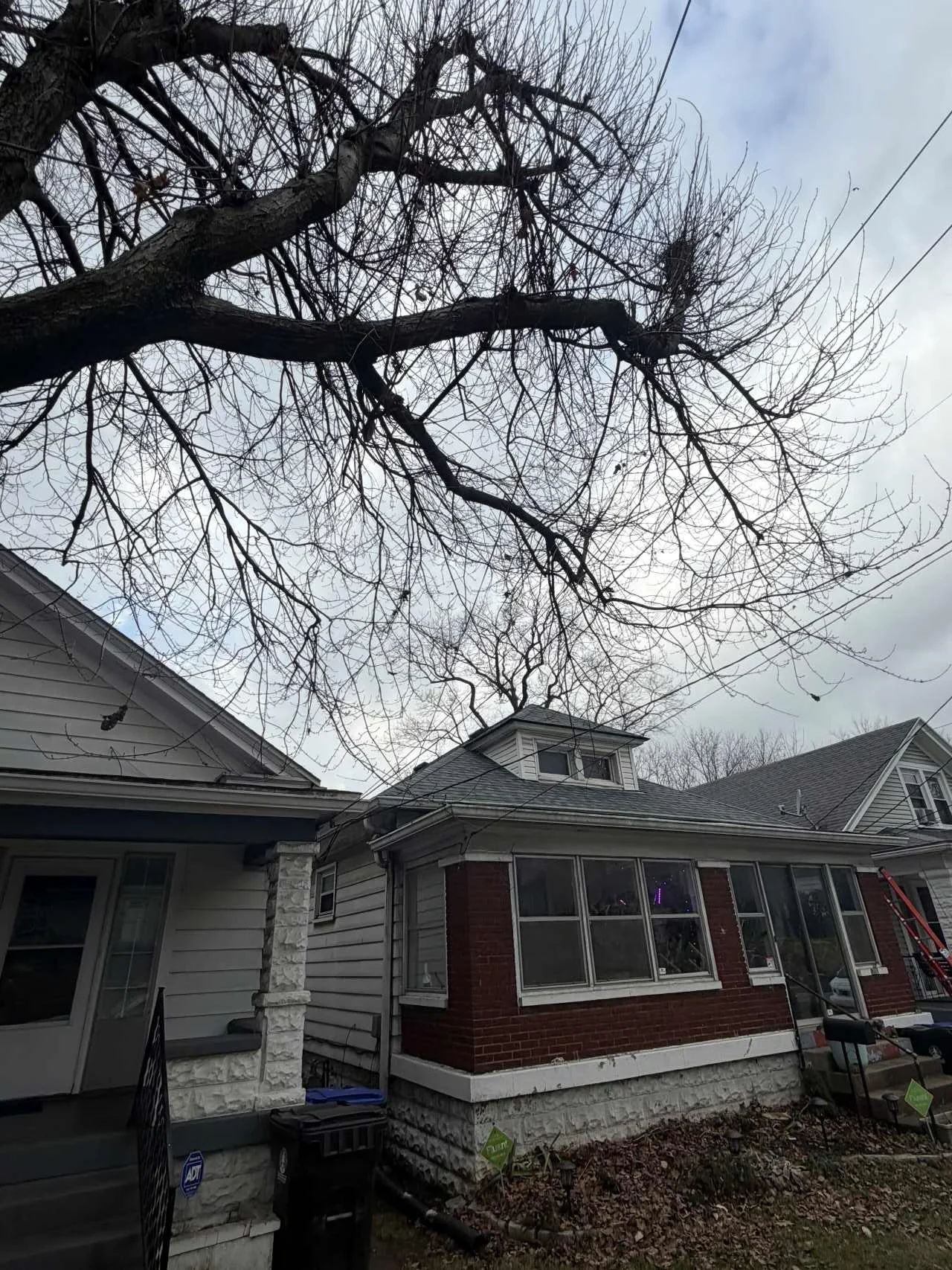
This brick bungalow’s roof presents the distinctive geometry common to Louisville’s older neighborhood housing stock — a primary hip roof covering the main structure with a raised central dormer featuring its own smaller hip and a front-facing window, all converging at multiple angles that create hip-to-hip junctions, valley intersections, and dormer transitions requiring specific flashing details at every point. The dormer rising from the main hip is the most demanding detail on this roof type — step flashing up each side, head flashing at the dormer’s upper edge, and the hip cap work where the dormer’s roof meets the surrounding main surface all require careful sequencing to produce watertight transitions.
New flashings at every one of these junctions were part of the complete replacement scope — not just the visible field shingles.
All New Flashings Across the Board
Every flashing on this roof was replaced as part of the Titan XT installation — the dormer step flashings, the hip transitions, the drip edge along every eave and rake, and any pipe penetration boots in the field. Replacing flashings during a re-roof is the correct approach and the one that produces lasting results, because leaving original flashings in place under new shingles means inheriting whatever deterioration those flashings had accumulated — and making them inaccessible without tearing off the new shingles to address future failures. On a rental property where the owners aren’t on-site daily, eliminating every flashing as a potential callback source is worth considerably more than the incremental cost of replacing them all.
The active front room leak that triggered the call was traceable to exactly this category of failure — a flashing that had outlived its service life and was admitting water at a transition point the shingle surface alone couldn’t protect.
Adding a Bathroom Exhaust Vent During Installation
The property owners requested one addition to the scope during the replacement — a new bathroom exhaust vent cut into the decking and installed on the roof surface so they could add a bathroom fan upgrade for future tenants without a separate roofing visit later. During a full replacement when the deck is accessible and the shingle installation sequence can accommodate a new penetration at any point in the layout, adding this vent costs a fraction of what a standalone roofing service call would charge for the same work. The vent was positioned where the owners needed it, properly flashed into the new Titan XT shingles, and integrated into the complete installation rather than retrofitted after.
This kind of forward-thinking scope addition is exactly how property owners get maximum value from a full replacement project.
Tamko Titan XT on a Rental Property
The Tamko Titan XT Class 3 impact-rated shingles installed here deliver performance that standard rental-grade dimensional shingles don’t match — stronger wind resistance, better hail resilience, and a product warranty that stands behind the installation for the long term. Rental property owners sometimes gravitate toward lower-cost shingle options to minimize upfront expenditure, but the math changes when the property is in a documented hail corridor and the last replacement ended with an active leak and hail damage across multiple slopes. Installing a Class 3 rated product means the next qualifying storm event meets a roof specifically engineered to handle it better than what it replaced.
The warm brown-gray Titan XT color also coordinates naturally with this bungalow’s red brick exterior — a detail that matters for a rental property where curb appeal influences tenant quality.
Rental Property Roofing by Ragnar Roofing
Downtown Louisville rental property owners dealing with leaking roofs, hail damage, or aging systems that have crossed into active liability territory need a roofing contractor who inspects thoroughly, scopes accurately, and delivers installations that protect the investment rather than just closing the current work order. Ragnar Roofing serves Louisville, KY and Jeffersonville, IN with complete storm damage assessments, full replacement installations, and the kind of scope flexibility that turned a leak repair call into a future-ready roof with a new exhaust vent already in place. Contact Ragnar Roofing at (831) 772-4627 to schedule your inspection.